
Resolve parenting and property disputes — without going to court.
Separation is hard enough. Mediation gives you and your former partner a structured, private space to reach agreements on children, property, and finances — with a nationally accredited mediator who is also a family lawyer.
Send an enquiry

Book a call
Testimonials & Reviews
Our Structured Mediation Process
1. Initial Enquiry
We speak with you briefly to understand your situation and confirm that mediation is appropriate. If there are safety concerns, intervention orders, or significant power imbalances, we'll discuss whether FDR is the right pathway.
2. Individual pre-mediation sessions
We meet with each party separately before the joint session. This gives everyone a chance to prepare, understand the process, and raise anything they'd prefer to address privately first.
3. Joint mediation session
Both parties meet with Shane as mediator. Sessions are structured but flexible — we set an agenda, work through each issue, and use private caucuses where needed. Available in person at Clarence Chambers, Melbourne, or by Zoom.
4. Agreement & Certificate
If agreement is reached, we assist with documenting the parenting plan or heads of agreement. If agreement isn't reached, Shane issues the appropriate Section 60I Certificate so you can proceed to court if needed.

Required before you can file for parenting orders.
Before filing a parenting application in the Federal Circuit and Family Court, you generally need a Section 60I Certificate issued by a registered FDRP. Shane is registered to issue these certificates.
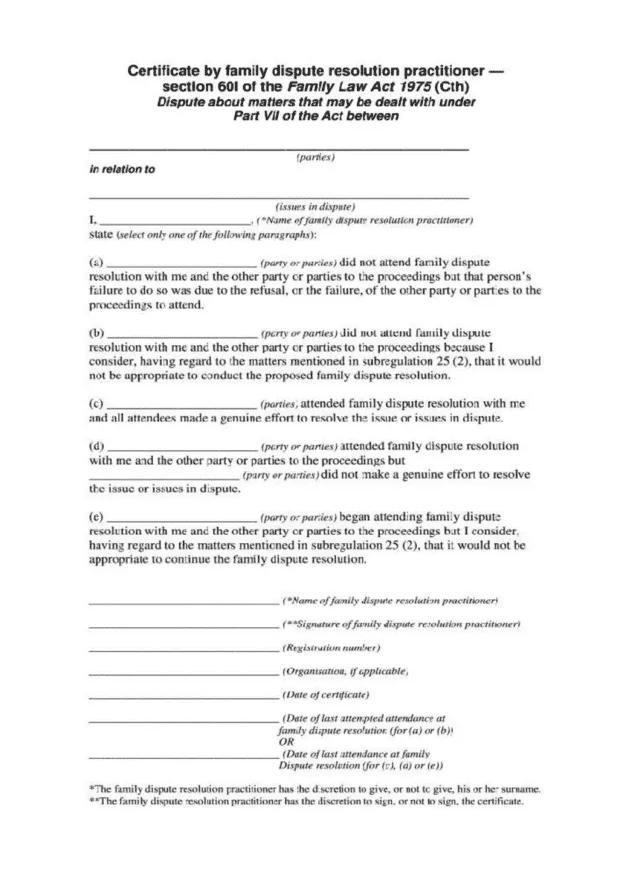
The certificate records the outcome of the mediation process — whether agreement was reached, whether a party failed to attend, or whether mediation was deemed inappropriate. It does not record what was said in the sessions. Exceptions apply where there is family violence, child abuse, or urgency — in those cases you may file without a certificate.
Types of Section 60I Certificates
Non-Attendance by One Party
Indicates that one party refused or failed to attend mediation
Inappropriate for Mediation
Issued when mediation is deemed unsafe or unsuitable due to factors such as family violence or power imbalances.
Genuine Effort Made by All Parties
Confirms that all parties actively participated in the mediation process.
Lack of Genuine Effort
Indicates that one party did not engage meaningfully in mediation.
Mediation Unable to Continue
Issued if mediation sessions break down and no resolution can be achieved.
Take the First Step Towards Resolution
Your family’s future matters—let’s resolve it together.

Shane McClure, Nationally Accredited Mediator, Shamac Lawyers
Nationally Accredited Mediator — Resolution Institute
Registered FDRP — Attorney-General’s Department
Authorised to issue Section 60I Certificates
Australian Lawyer – 20+ years Victorian family law
Zoom mediations available Australia wide or in-person at Clarence Chambers, Melbourne
Most FDR practitioners come from counselling. Shane comes from family law.
Shane does not provide legal advice during mediation — his role is neutral facilitation — but his legal background means the process is grounded in reality.
You won’t leave the session with an agreement that unravels when you see a lawyer afterwards.
When legal questions arise in the room — about what a court would likely order, whether a proposed arrangement is legally sound, or what a Section 60I Certificate requires — Shane can speak to those questions directly.
Family disputes handled with care and legal expertise

Parenting Arrangements
Time with each parent, decision-making responsibilities, schooling, travel, and holiday schedules.

Financial & Property Settlements
Division of assets, liabilities, and superannuation in a fair and documented way.

Child Support
Issuing of the necessary certificate for court proceedings if mediation fails.

Co-parenting Communication
Practical frameworks that reduce conflict and keep the focus on your children's wellbeing.
Six reasons mediation works better than court for most families.
Decisions stay with you
Mediation empowers you to craft agreements that suit your family’s unique needs, rather than having a decision imposed by a judge.
Significantly less expensive
Even a short court process costs far more than private mediation. The savings are substantial — and the outcome is often better.
Faster resolution
No waiting for court listings. Private mediation can be arranged quickly, keeping your matter moving when it matters most.
Better for your children
Cooperative agreements reached away from court are more likely to be followed and easier to live with long term.
Confidential
What is said in mediation cannot generally be used as evidence in court. You can speak frankly without fear.
Preserves the co-parenting relationship
A collaborative process is far less damaging to long-term co-parenting than adversarial litigation.

Resolve parenting arrangements without handing control to a court
Family Dispute Resolution gives separated parents a structured and supported way to resolve parenting issues outside court.
With the assistance of an independent Family Dispute Resolution Practitioner, you can work through matters such as living arrangements, time with each parent, holidays, communication, changeovers and important decisions concerning the children.
The focus is not on winning or losing. It is on identifying practical, child-focused arrangements that both parents can understand and follow. You remain involved in shaping the outcome, rather than asking a judge to impose one.
In most parenting matters, Family Dispute Resolution must be attempted before court proceedings can begin. Shane is an accredited Family Dispute Resolution Practitioner and can conduct the mediation and, where appropriate, issue the section 60I certificate required to commence parenting proceedings.
Private FDR with Shamac Lawyers offers timely access, a clear process and mediation informed by a strong understanding of Australian family law.

Why Choose Private Mediation With Shamac Lawyers, instead of Court?

Faster Access to Mediation
Private FDR can usually be arranged far sooner than a court hearing. Earlier intervention can help prevent disagreements from becoming more entrenched and allow your family to begin working towards a resolution promptly.

Lower Legal & Emotional Costs
Mediation is generally far less expensive than contested court proceedings. It can also reduce the emotional strain of prolonged litigation by focusing on practical solutions rather than ongoing conflict.

Greater Control Over the Outcome
In mediation, you and the other party make the decisions. This gives you greater flexibility to develop arrangements that reflect your children’s needs, your circumstances and the realities of family life.

A Child-Focused Process
FDR keeps attention on the children’s safety, wellbeing and ongoing relationships. The process helps parents move beyond past conflict and focus on workable parenting arrangements for the future.

Private and Confidential
Mediation takes place in a private and structured environment. Subject to limited legal exceptions, discussions remain confidential, allowing both parties to explore possible solutions openly and constructively.
Flexible and Practical Solutions
Unlike court orders, which are confined by the evidence and orders sought, mediation allows families to discuss practical details such as routines, holidays, communication, changeovers and decision-making.

Better Communication Going Forward
A negotiated outcome can reduce hostility and establish clearer expectations between parents. This can make future communication and co-parenting more manageable, particularly where the parties will remain connected through their children.

A Clear Path Forward
Where agreement is reached, the outcome can be documented and, where appropriate, formalised through a parenting plan or consent orders. If mediation is unsuccessful or unsuitable, an accredited FDR practitioner may issue a section 60I certificate where the legal requirements are met.
Once both parties agree on a resolution, it can be formalised into a legally binding document—ensuring clarity and protecting both sides from future disputes.
The mediation process is tailored to your family’s unique needs. Here’s what you can expect:
Initial Consultation: Discuss your situation with our team to determine if mediation is suitable.
Pre-Mediation Preparation: Identify key issues and set clear goals.
Mediation Sessions: Work with a trained mediator in a confidential setting to negotiate and reach agreements.
Drafting Agreements: Finalise agreements on parenting, property, or financial matters.
Post-Mediation Support: Mediation agreements are not automatically legally binding. However, if both parties agree, the terms can be formalised through Consent Orders or a Binding Financial Agreement, ensuring the agreement is enforceable.

STILL NOT SURE?
Common questions about mediation and FDR.
What is family law mediation?
Family law mediation is a structured process where a neutral third party, the mediator, helps separated or divorcing couples resolve disputes about parenting arrangements, property settlements, and other family-related issues. Mediation focuses on fostering communication and finding mutually acceptable solutions without the need for court intervention.
Do both parties have to agree to mediation?
Both parties need to participate for joint mediation to proceed. If the other party refuses, Shane can still conduct the process, attempt to contact them, and issue a certificate recording their non-attendance — which you can then use to file in court.
What if there has been family violence?
Safety is the first consideration. We conduct a screening assessment before any joint session. In some cases, shuttle mediation — where parties are in separate locations or on separate Zoom calls — can still work. In others, mediation isn’t appropriate and we’ll tell you that clearly.
Is mediation confidential?
Yes. What is said in mediation is confidential and generally cannot be used as evidence in court proceedings. There are limited exceptions — for example, if a child’s safety is at risk.
How long does it take?
Pre-mediation sessions are typically 45–60 minutes each. The joint session is usually 2–3 hours, sometimes longer for complex matters. Sessions are available in person at Clarence Chambers, Melbourne, or by Zoom.
What does it cost?
Contact us for a quote. Fees depend on the complexity of the matter and the number of sessions required. Private mediation is typically significantly less expensive than even a single day in court.
What if we can't reach agreement?
Shane will issue the appropriate Section 60i Certificate reflecting the outcome, which allows you to file in court if that becomes necessary. Mediation doesn’t close off any options — it opens them.
How can Shamac Lawyers assist with mediation?
At Shamac Lawyers, our experienced family lawyers provide guidance and support throughout the mediation process. We help you prepare, ensure your rights are protected, and work towards achieving a fair and amicable resolution that meets your needs. If mediation fails, we are ready to represent you in court with compassion and expertise.
How long does family mediation take?
It depends on the complexity of the dispute. Some cases are resolved in one or two sessions, while others may take a few weeks. Mediation is generally much faster than court, allowing families to reach agreements without unnecessary delays.
Is family mediation legally binding?
Mediation itself isn’t legally binding, but agreements can be formalised into a legally enforceable document—such as a consent order or a financial agreement. A family lawyer can help with this process to ensure your rights are protected.
What happens if mediation fails?
If mediation doesn’t result in an agreement, parties may need to go to court. However, Australian law requires most parenting disputes to attempt mediation before proceeding to trial. If mediation is unsuccessful, a Section 60I Certificate will be issued, allowing the case to move forward in court.
Can property settlements be resolved through mediation?
Yes. Family mediation services in Melbourne are commonly used to negotiate property settlements. If an agreement is reached, a financial agreement lawyer can ensure that the terms are legally binding and enforceable.